 tap
tap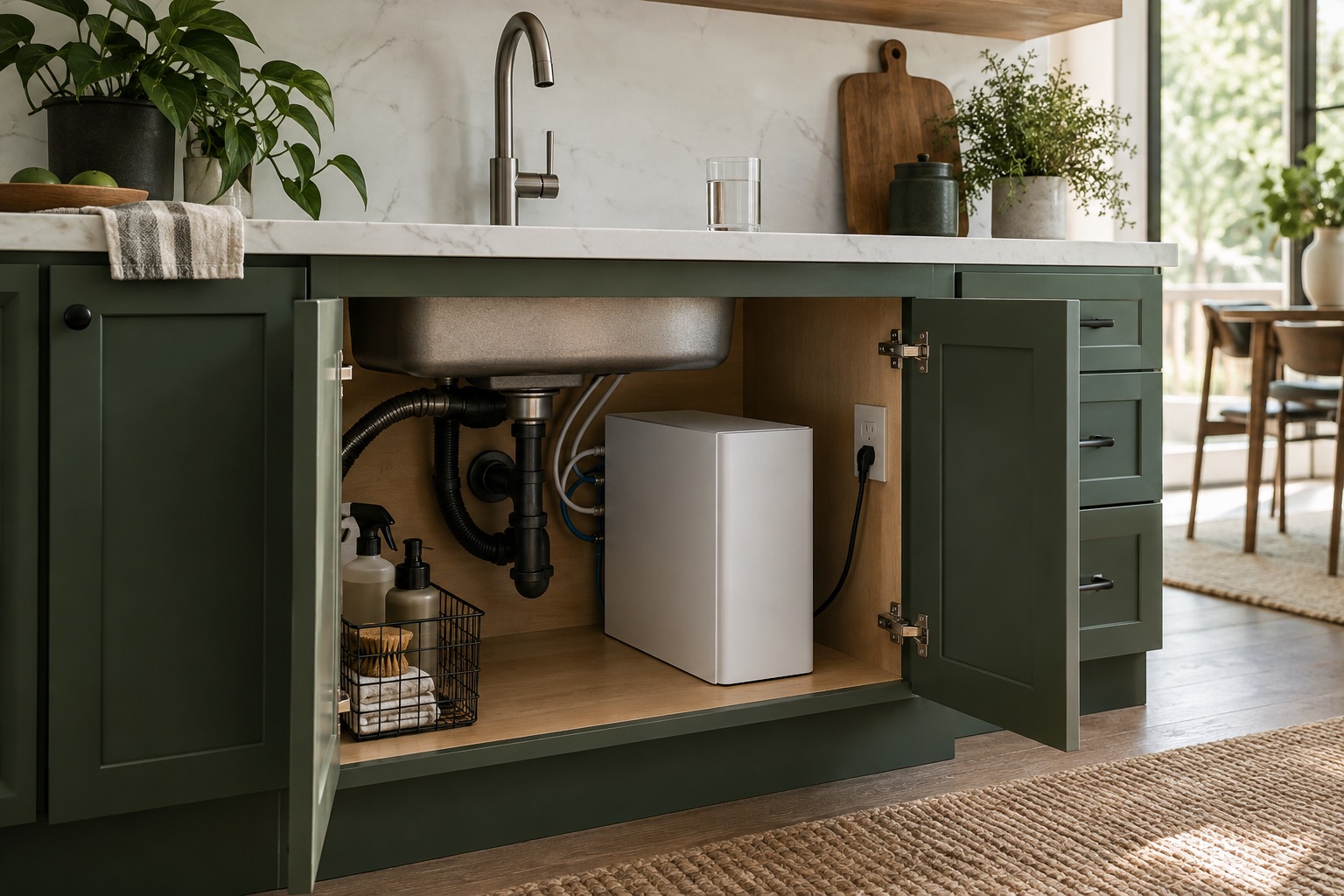
Our recommendation
The G3P800 makes the most sense for a household that wants fast tankless reverse osmosis, has room for a dedicated faucet and power outlet, and accepts three separate filter schedules. Skip it when a simple carbon filter solves the problem or when the installation cannot support power, drain and faucet changes.
| If this sounds like you | Best next move | What decides it |
|---|---|---|
| You want high-output tankless RO | Put the G3P800 on the shortlist | Confirm pressure, power, drain and faucet fit first. |
| You want the fewest replacement parts | Compare a simpler system | The G3P800 uses CF, CB and RO cartridges. |
| You only want chlorine taste reduction | Price a certified carbon filter too | RO may add cost and reject water without adding useful value. |
In this guide
- G3P800 specifications in plain English
- What the G3P800 is certified to reduce
- Using the smart faucet every day
- Installation and cabinet fit
- Replacement filters and maintenance
- What the G3P800 may cost over five years
- How much water does it send to the drain?
- Who should buy the G3P800
- Who should choose a simpler filter
- Warranty and returns
- Common G3P800 questions
- Final G3P800 buying checklist
- Frequently asked questions
- Sources & editorial notes
G3P800 specifications in plain English
Waterdrop lists the G3P800 as an 800-GPD, electrically powered, tankless reverse-osmosis system with a 3:1 purified-to-drain ratio. The cabinet body is listed at about 18.11 inches wide, 5.67 inches deep and 17.73 inches high. Those numbers help with a first measurement, but they do not include every tube bend, connector, power lead or the space your hands need for installation and filter replacement.
The 800-GPD figure is a production-capacity label under specified conditions, not a promise that every kitchen faucet will deliver the same experience. Feed pressure, water temperature, incoming dissolved solids and the condition of the filters can affect real output. For most buyers, the useful question is simpler: can it fill the containers you use at a speed you find comfortable?
What the G3P800 is certified to reduce
The current G3P800 page describes a 10-stage process and lists certification against NSF/ANSI 42, 53, 58 and 372. NSF/ANSI 58 is the main reverse-osmosis system standard; the presence of a standard number does not mean every possible contaminant under that standard was tested. The performance document for the exact model should name the reduction claims and test conditions.
Do not buy from a general statement such as “removes 99% of contaminants.” Start with the substance you care about, then locate that substance in the model-specific performance data. If the concern comes from a laboratory result, ask a qualified water-treatment professional to interpret the result and confirm that point-of-use RO is an appropriate response.
Using the smart faucet every day
The supplied faucet displays information intended to help with filter status and treated-water quality. That can make day-to-day ownership easier because the reminder is visible where you collect water. It also means the faucet is part of the system rather than a decorative item you can freely replace without checking compatibility.
A TDS reading is not a complete water-safety test. It reports dissolved solids, not the identity of every substance in the water, and it does not replace a laboratory result when a specific contaminant matters. Treat the display as an operating indicator. If the reading changes unexpectedly, consult the manual and support rather than diagnosing the water from one number.
Installation and cabinet fit
A tankless layout saves the volume that a pressure tank would occupy, but the G3P800 still needs four practical things: a cold-water feed, a drain connection, a compatible faucet opening and electrical power. Measure all four. Check whether the existing soap-dispenser or accessory hole can be used; otherwise ask what drilling would involve for your sink or countertop material.
Keep the power adapter and outlet away from leaks and follow the installation instructions. If a new receptacle, altered drain or unfamiliar plumbing connection is required, include qualified labor in the price comparison. A clean-looking product photo does not show a disposal, shutoff valves, deep sink bowl or crowded pipework competing for the same space.
Make a paper or cardboard footprint using the published dimensions, then place it in the actual cabinet. Open the doors fully and check whether the disposal, trap, supply valves or stored items block access. Leave enough room to disconnect and replace filters without forcing tubing against a sharp edge.
Also plan for inspection. You should be able to look for drips after installation and after a filter change. A system squeezed behind a bin may technically fit while being difficult to maintain. If two possible locations work, favor the one that keeps shutoffs, connections and cartridges easiest to reach.
Replacement filters and maintenance
The current product information lists three core cartridges: G3-N1CF for up to six months or 550 gallons, G3-N3CB for up to twelve months or 1,100 gallons, and G3P800-N2RO for up to twenty-four months or 2,200 gallons. “Up to” matters. Usage and incoming water conditions can shorten the interval, and the machine’s reminder should be read together with the manual.
Before buying, open each replacement listing and confirm availability, current price and exact compatibility. Save the part numbers in your home record. A sensible first-year budget includes two CF cartridges and one CB cartridge if the time limits are reached; the RO membrane may fall into a later year. Do not assume a bundle contains every filter needed for the period named in its title.
What the G3P800 may cost over five years
Use today’s system price only as one line. Add installation, any faucet or countertop work, and the replacement cartridges expected during five years under the published limits. Then add a service allowance if you will pay someone to change filters or troubleshoot the system. Do not lock today’s promotional cartridge prices into a five-year forecast; record them as a starting snapshot.
Run the same calculation for a conventional tank RO system and for a simpler certified carbon filter that addresses the same concern. This prevents the G3P800 from winning merely because it is being compared with nothing. The correct comparison is between suitable treatment options, not between the most advanced-looking products.
How much water does it send to the drain?
A 3:1 purified-to-drain claim means three units of treated water for one unit sent to the drain under the stated test conditions. That is substantially different from older inefficient RO systems, but it still creates a reject stream. Real household efficiency can vary with water conditions and operation.
EPA’s WaterSense program now covers point-of-use RO systems and requires independent certification for efficiency and performance criteria. Do not assume that an advertised ratio means a model carries the WaterSense label. Check the current WaterSense product listing if that label affects your decision, and compare only claims expressed on the same basis.
Who should buy the G3P800
The strongest buyer is someone who has a defined reason for RO, wants treated water on demand, lacks room for a pressure tank and is comfortable owning an electronic appliance with proprietary filters. A household that fills several reusable bottles, a kettle and cooking pots may notice the delivery benefit more than a person who fills one glass at a time.
It can also suit a buyer who values a visible filter-life indicator and wants a narrow cabinet body. These are convenience reasons, not treatment claims. The treatment decision still comes first, followed by installation fit and five-year cost.
Who should choose a simpler filter
If the only complaint is chlorine taste or odor and a model-certified carbon filter addresses it, a non-RO filter may cost less, use no electricity and send no treatment water to the drain. If the household rents, cannot alter the drain or faucet, or has no suitable outlet, a less permanent format may be easier to own.
A person who wants generic cartridges available from many suppliers may also prefer a conventional system. Proprietary quick-change filters make servicing cleaner but tie the owner to exact compatible parts. Neither design is automatically better; decide whether convenience or broader serviceability matters more in your home.
Warranty and returns
Waterdrop’s current service policy describes a 30-day return window for orders in the continental United States, but customers may be responsible for return shipping on non-quality returns and products must be disassembled and repacked. Third-party purchases follow the seller’s policy instead. Read the version that applies to the store where you buy.
The service policy says most Waterdrop RO systems carry a one-year limited warranty, while eligible X Series systems carry two years. The exact G3P800 coverage should therefore be confirmed in writing on the product page or order record. Installation can make a large appliance harder to return, so settle faucet fit, drain fit and cabinet measurements first.
Common G3P800 questions
Does it work during a power outage? Treat normal operation as power-dependent and ask Waterdrop what, if anything, remains available. Can it treat private-well water? Do not assume so; obtain source-water requirements and pretreatment guidance for the exact installation. Does remineralization come standard? The base G3P800 and optional mineral or alkaline add-ons should not be treated as the same package.
Can the faucet be swapped? Ask for supported faucet compatibility before buying another style. Does the 3:1 ratio eliminate waste? No; it describes a more efficient purified-to-drain relationship, not zero reject water. Can the display prove the water is safe? No; it is an operating aid, not a complete contaminant test.
Final G3P800 buying checklist
Buy only when you can check every box: the exact reduction claim matches the goal; the source water fits the operating requirements; the cabinet has usable service space; a safe outlet and drain route exist; the faucet plan is settled; and the three replacement cartridges fit the household budget. Keep screenshots or PDFs of the applicable performance and warranty information with the receipt.
If any of those answers is missing, pause at that question instead of substituting a sale banner. The G3P800 can be a capable, convenient system, but its value comes from a correct match between water need, kitchen fit and ownership plan.
Products mentioned
Waterdrop G3P800
Confirm the exact package, faucet, current performance documents and replacement-filter bundle.
Frequently asked questions
Is the Waterdrop G3P800 worth considering?
The G3P800 makes the most sense for a household that wants fast tankless reverse osmosis, has room for a dedicated faucet and power outlet, and accepts three separate filter schedules. Skip it when a simple carbon filter solves the problem or when the installation cannot support power, drain and faucet changes.
Who is the Waterdrop G3P800 best for?
You want high-output tankless RO. Put the G3P800 on the shortlist. Confirm pressure, power, drain and faucet fit first.
What should I check before buying the Waterdrop G3P800?
Measure the cabinet and price every G3P800 replacement filter before ordering.
Ready to choose? See Waterdrop G3P800 at Waterdrop ↗
Put this guide to work
Compare the complete ownership cost
Use the free tool, then download a record you can keep. No email required.
Open the tool →Get the editable pack →Sources & editorial notes
This guide combines published information with our suggested decision process. It does not report hands-on product testing or an assessment of your property.
- Waterdrop: G3P800 product specifications and replacement filters
- EPA WaterSense: point-of-use reverse osmosis systems
- Waterdrop: service, return and warranty policy
Product details can change. Confirm the exact model and current terms before ordering. How we write and update guides.