 tap
tap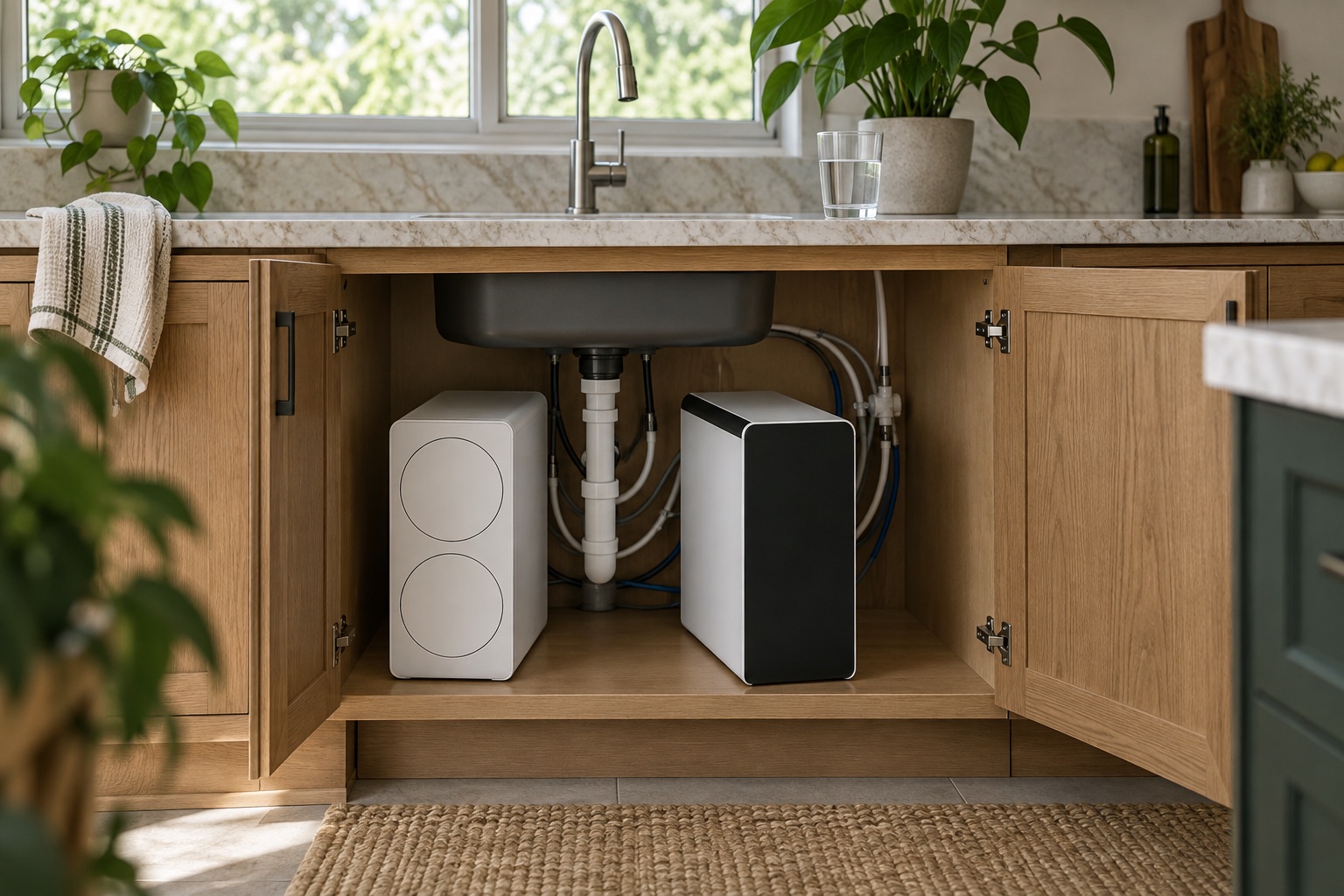
Our recommendation
The G3P800 is the value-oriented choice for households satisfied with its 800-GPD platform and three-filter schedule. The X12 is the premium candidate when its higher-output design and exact feature package provide a benefit you can name. Most homes should not pay more for X12 on the GPD number alone.
| If this sounds like you | Best next move | What decides it |
|---|---|---|
| You want a proven lower-priced Waterdrop format | Start with G3P800 | Check its faucet and filter schedule. |
| You regularly need faster large-volume filling | Compare the exact X12 version | Verify the performance at your supply conditions. |
| Your main goal needs only carbon filtration | Skip both for now | Compare a certified non-RO system. |
In this guide
- Quick verdict and the versions compared
- What each system is certified to reduce
- 800 GPD vs 1,200 GPD in plain English
- Cabinet fit and faucet experience
- Replacement filters and five-year cost
- Does X12 remineralization matter?
- How much water does each system use?
- Warranty and returns
- Who should buy which model
- Who should buy neither system
- Electricity, noise and power outages
- Common questions and final recommendation
- Frequently asked questions
- Sources & editorial notes
Quick verdict and the versions compared
Both systems are powered, tankless, under-sink RO appliances with dedicated smart faucets and a published 3:1 purified-to-drain ratio. The G3P800 is listed at 800 GPD and the X12 at 1,200 GPD. The X12 also adds alkaline remineralization in the standard mineral version and a faucet designed for measured-volume dispensing.
Those differences do not automatically make X12 the winner. GPD is a production rating, not a household score. If G3P800 already fills your normal containers quickly enough, the additional capacity may deliver little practical value. The X12 premium is easier to justify when its exact faucet functions, remineralization or delivery benefit solves something you will use regularly.
Waterdrop currently markets several closely related names: X12 Basic, X12, X12-PRO and finish variants. The standard X12 includes alkaline remineralization, while Basic and Pro packages can differ in water path, faucet or feature set. Search results and retailer listings may combine neighboring versions, so copy the complete model and variant into your comparison.
The affiliate button on this guide goes to the X12 family listing. Confirm the selected variant before checkout. A lower price may reflect Basic rather than the configuration described here, and a higher price may include a finish, added warranty or filter bundle. Compare the contents of the cart, not the family headline.
What each system is certified to reduce
Waterdrop currently lists X12 certification against NSF/ANSI 42, 58 and 372 through IAPMO R&T, with reduction claims specified in its performance data. The G3P800 page lists standards 42, 53, 58 and 372. The extra standard number is not a simple “better” score; the exact tested claims under each standard matter.
For either system, locate the substance you care about in the applicable model document. A general RO statement cannot substitute for a model-specific claim. If your water report identifies a health-related concern, use qualified guidance to decide whether point-of-use treatment is appropriate and how to verify performance after installation.
800 GPD vs 1,200 GPD in plain English
A GPD rating describes potential daily production under defined conditions. It does not mean a household will use hundreds of gallons of drinking water, and it should not be converted directly into a guaranteed faucet flow without the tested conditions. Water temperature, pressure, incoming TDS and filter condition all influence the experience.
Think in containers. Time how long you are comfortable waiting for a glass, kettle, coffee machine reservoir and largest cooking pot. Ask Waterdrop for comparable delivered-flow information for both exact models. The X12 earns its premium only if the difference affects tasks you actually perform.
Cabinet fit and faucet experience
The G3P800 body is currently listed at about 18.11 by 5.67 by 17.73 inches. The X12 is listed at about 18.2 by 6.25 by 16.72 inches. X12 is slightly deeper and slightly shorter on those published dimensions, but both need tubing, connections and room for cartridge changes.
Create two cardboard footprints and place them around the disposal, trap and shutoff valves. Check door clearance and the route to the faucet, drain and outlet. A half-inch difference can matter in a crowded cabinet, but accessible service space is usually more important than the bare product volume.
G3P800 uses a smart display faucet intended to show TDS and filter-life information. X12 adds digital controls and measured-volume dispensing on its current standard configuration. If you routinely fill the same bottle or kettle, that feature may be convenient. If you prefer a simple lever, it may add complexity without much benefit.
Neither faucet display is a laboratory. A TDS number does not identify every contaminant or prove safety. Compare screen readability, control method, required opening size and replacement availability. Since the faucet is central to daily use, do not treat it as a minor accessory.
Replacement filters and five-year cost
G3P800 uses G3-N1CF, G3-N3CB and G3P800-N2RO cartridges, currently listed for up to six, twelve and twenty-four months respectively, with gallon limits as well. X12 uses F2, F1A and X12-F3 on the same broad six-, twelve- and twenty-four-month pattern in current listings.
At the prices displayed during our research, Waterdrop’s own estimated annual filter cost was higher for X12 than G3P800, but prices and bundles change. Rebuild the estimate at checkout. Count each cartridge due over five years, use both time and gallon limits, and include shipping or service where relevant.
Start with the delivered system price for the exact variant, then add every cartridge that reaches either its time or gallon limit during five years. Add installation, optional warranty, any remineralization consumable, and paid service you expect to use. Keep promotions in a separate column so the decision still makes sense after a sale ends.
Then write the practical benefit beside the cost difference. For example: “X12 costs $___ more over five years and gives us measured-volume dispensing plus the higher rated output.” If that sentence describes a benefit the household values, the premium may be reasonable. If the second half stays vague, G3P800 is the stronger financial choice.
Does X12 remineralization matter?
The standard X12 is marketed with alkaline remineralization, while the base G3P800 does not include the same feature unless a separate compatible add-on or bundle is selected. Remineralization can change taste and adds minerals after RO; it should not be treated as a medical benefit. Promotional health statements are not a sound reason to pay more.
If you prefer the taste of remineralized RO water, that is a legitimate usability preference. Confirm which X12 variant includes it and whether it adds another replacement part. If you do not care about this feature, compare X12 Basic or G3P800 rather than paying for a benefit you will not value.
How much water does each system use?
Both pages currently advertise a 3:1 purified-to-drain ratio. On the same basis, that implies similar treatment efficiency: three units of treated water for one unit sent to the drain under stated conditions. It does not mean either system wastes no water, and real efficiency can vary.
EPA’s WaterSense label is a separate, independently certified efficiency and performance program for point-of-use RO systems. An advertised ratio alone is not the WaterSense label. If efficiency certification matters, check the current WaterSense product database for the exact model rather than assuming both qualify.
Warranty and returns
Waterdrop currently presents X12 with a two-year warranty and optional paid extensions on eligible official-site purchases. Its general service policy says most other RO systems include a one-year limited warranty, so G3P800 buyers should confirm the exact written duration before checkout. The X12 page itself contains some inconsistent warranty wording, making the order record especially important.
The current official-store return policy describes a 30-day window within the continental United States, with conditions for repacking and possible customer-paid return shipping on non-quality returns. A third-party seller may use different terms. Because both products require plumbing work, clarify whether installation affects return eligibility before installing.
Who should buy which model
G3P800 is the stronger starting point when the exact reduction documentation meets your goal, its delivery is already sufficient and its lower complete cost leaves no meaningful sacrifice. It also makes sense when you do not want alkaline remineralization or measured-volume faucet controls.
“Value” should include installation and filters, not only the machine price. If the G3P800 requires fewer changes to fit your cabinet or you find its cartridges easier to budget, those are durable advantages. It does not need to beat X12 on specifications it does not need.
Choose X12 when the measured-volume faucet, standard remineralization, two-year warranty or higher rated output has a clear role in your household. A family that repeatedly fills large containers may appreciate the delivery difference more than a one-person home. The exact inlet conditions still determine whether that advantage appears in practice.
Write down the premium feature before checking the price. If you cannot name it, G3P800 is probably the more rational shortlist candidate. If you can name it, confirm that the selected X12 variant includes it and that its replacement-filter plan remains acceptable.
Who should buy neither system
Neither is the right first purchase when the water concern is undefined, a suitable non-RO carbon filter meets the only goal, or installation cannot safely support a drain, faucet and outlet. Renters should obtain written permission before altering plumbing or a countertop. Private-well users should confirm source-water limits and pretreatment needs rather than assuming a premium model accepts every well.
Both systems are also poor fits for someone unwilling to buy proprietary cartridges or maintain an electronic appliance. A conventional tank RO system may be slower and larger but can offer a different service model and some stored treated water. Compare formats before assuming tankless is always an upgrade.
The X12 extended-warranty information currently lists operating conditions including 14.5–87 psi inlet pressure, 41–100°F water, pH 6.5–8.5, TDS below 750 ppm, hardness below 7 grains per gallon and municipal tap water, with pretreatment mentioned for wells. Treat these as a reason to verify the current manual, not as permission to assume G3P800 has identical limits.
Ask Waterdrop to confirm the applicable limits for both exact models against your source water. Hard water, sediment or unusual well chemistry can affect membranes and filter life. If the answer involves pretreatment, add that equipment, service and space to the comparison before deciding which RO machine is cheaper.
Electricity, noise and power outages
Both systems require electricity for normal operation. That means pump sound, access to an outlet and outage behavior belong in the buying decision. Neither should be assumed to provide the stored reserve of a conventional pressure-tank system. Ask what happens at the faucet when power is lost and whether any restart procedure is required.
Noise tolerance is personal and product-page adjectives are not measurements in your cabinet. A hollow cabinet can make operating sounds more noticeable. If quiet operation matters, ask for comparable sound information and read owner reports for recurring patterns, while remembering that installation and surrounding cabinetry can change what people hear.
Common questions and final recommendation
Is X12 automatically cleaner because it has more stages? No. Stage counts are not a reliable ranking; compare the exact certified reduction claims. Is 1,200 GPD fifty percent faster at the faucet than 800 GPD? The labels alone do not establish that experience in your home. Ask for comparable delivered-flow data and conditions. Does G3P800 have a tank? No; both models discussed here are tankless and powered.
Does X12 always include alkaline water? Check the exact variant; family listings include different configurations. Are their filters interchangeable? Do not assume so—use the part numbers assigned to each model. Will either work with every private well? No. Confirm source-water requirements and pretreatment. Which is cheaper? G3P800 usually starts lower, but the decision should use the current system, installation and five-year cartridge totals.
For most households choosing only between these two, start with G3P800. Move to X12 when the exact X12 feature set produces a real daily benefit worth the higher equipment and filter cost. Do not choose from stage count, crossed-out price, a vague health claim or GPD alone.
Before ordering, save the exact cart contents, performance document, filter part numbers, warranty and return terms. Measure the cabinet and confirm the faucet opening, drain and power route. If X12 still wins after those checks, its premium is defensible; if not, G3P800 is the cleaner value choice.
Products mentioned
Waterdrop X12
Confirm the exact X12 version and filter set.
Waterdrop G3P800
Confirm the faucet bundle and three replacement-filter prices.
Frequently asked questions
Which should I choose in the Waterdrop X12 vs G3P800 comparison?
The G3P800 is the value-oriented choice for households satisfied with its 800-GPD platform and three-filter schedule. The X12 is the premium candidate when its higher-output design and exact feature package provide a benefit you can name. Most homes should not pay more for X12 on the GPD number alone.
What should decide the comparison?
You want a proven lower-priced Waterdrop format: start with g3p800. Check its faucet and filter schedule.
What should I do before ordering?
Compare exact-version quotes and five-year filters—not advertised discount percentages.
Ready to choose? See Waterdrop X12 at Waterdrop ↗ or See Waterdrop G3P800 at Waterdrop ↗
Put this guide to work
Compare the complete ownership cost
Use the free tool, then download a record you can keep. No email required.
Open the tool →Get the editable pack →Sources & editorial notes
This guide combines published information with our suggested decision process. It does not report hands-on product testing or an assessment of your property.
- Waterdrop: G3P800 product specifications and replacement filters
- Waterdrop: X12 reverse osmosis system
- EPA WaterSense: point-of-use reverse osmosis systems
- Waterdrop: service, return and warranty policy
Product details can change. Confirm the exact model and current terms before ordering. How we write and update guides.